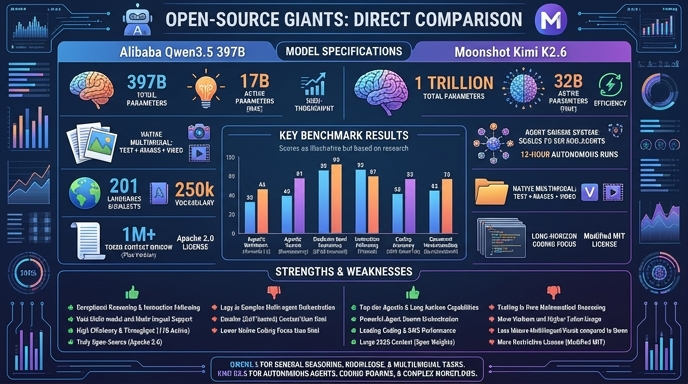
Qwen3.5 397B and Kimi K2.6 represent the current frontier of open-weight large language models, both released in early 2026. Qwen3.5 397B, an Alibaba-developed Mixture-of-Experts (MoE) model, offers a powerful, general-purpose solution with an Apache 2.0 license, making it highly attractive for enterprises requiring permissible commercial use and broad multilingual support. It balances reasoning capabilities with inference efficiency, leveraging a 17B active parameter routing mechanism to deliver high performance at a fraction of the compute cost of its dense predecessors.
Kimi K2.6 from Moonshot AI, released shortly after in April 2026, represents a specialized evolution focused heavily on agentic workflows and autonomous coding. Built with a massive 1 trillion total parameter architecture and agent-swarm orchestration capabilities, it is engineered to outperform frontier models in long-horizon tasks—such as complex software engineering pipelines—where models must manage multi-step reasoning, tool execution, and continuous state maintenance over extended sessions.
Visual comparison
Click to view full size
Benchmark scores
Higher is better
Strengths and weaknesses
When to use each model
Choose Qwen3.5 397B when your priority is a versatile, enterprise-ready generalist model that can be self-hosted with permissive licensing. It is the ideal choice for teams building RAG systems, multilingual applications, or general reasoning assistants where operational cost-efficiency and Apache 2.0 compliance are critical deployment requirements.
Choose Kimi K2.6 if your primary objective is autonomous software engineering or building complex, multi-agent workflows that require long-horizon reliability. Its specialized agent-swarm architecture makes it the superior choice for high-stakes, multi-step tasks where the model must autonomously manage development environments, execute tool chains, and maintain context over long-running sessions.
Ready to build?
Try both models on Select
One API key. Intelligent routing. Qwen3.5 397B and Kimi K2.6 available now.
Open Select →Pay as you go. No subscription required.