Choosing between Qwen3 Coder Next and Claude Sonnet 4.6 represents a significant decision for modern software engineering teams, balancing the flexibility of open-weights models against the managed, frontier-level reasoning of proprietary systems. Qwen3 Coder Next has gained traction for its highly efficient Mixture-of-Experts architecture, designed specifically for developers who require local execution or cost-optimized agentic workflows. It excels at delivering high-speed inference on consumer hardware, making it a powerful tool for repository-scale code generation and local debugging.
Conversely, Claude Sonnet 4.6 operates as a premier managed service, offering state-of-the-art reasoning and agentic reliability. Engineered for teams that prioritize integration, scalability, and minimal maintenance, it provides near-Opus level capabilities at a price point that makes it accessible for high-volume production environments. For developers, the choice often hinges on whether they need the granular control of an open-weights deployment or the consistent, battle-tested performance of Anthropic's latest managed infrastructure.
Visual comparison
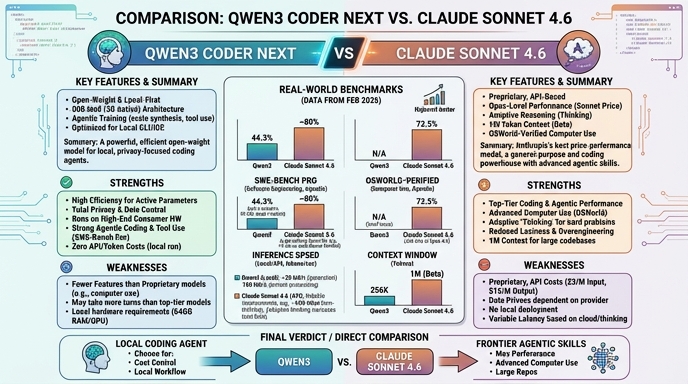
Click to view full size
Benchmark scores
Higher is better
Strengths and weaknesses
When to use each model
Choose Qwen3 Coder Next when your primary constraints are data sovereignty, budget, or the need to operate within a specific air-gapped or local development environment. It is the ideal engine for building custom, fine-tuned agentic harnesses where you control the inference hardware and need to minimize per-token costs across millions of requests. Its architecture is specifically optimized for developers who want to run advanced coding models on workstations without relying on external API stability.
Choose Claude Sonnet 4.6 when you require maximum reliability, minimal maintenance, and state-of-the-art reasoning for mission-critical software engineering tasks. It is best suited for product teams, enterprise SaaS providers, and developers building agentic workflows where the model must reliably navigate complex tool chains, manage multi-step reasoning, and deliver consistent, production-ready code output without the overhead of maintaining local inference infrastructure.
Ready to build?
Try both models on Select
One API key. Intelligent routing. Qwen3 Coder Next and Claude Sonnet 4.6 available now.
Open Select →Pay as you go. No subscription required.