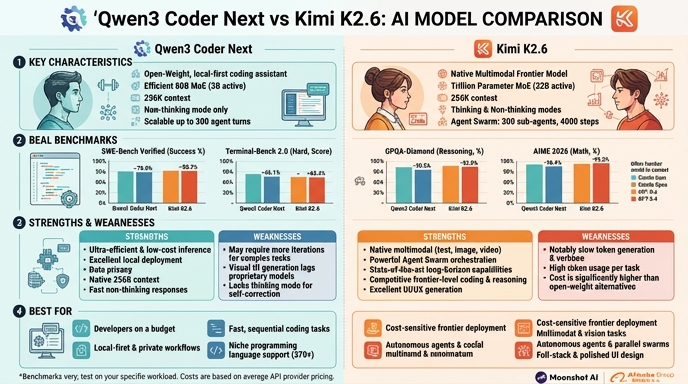
Qwen3 Coder Next and Kimi K2.6 represent the new generation of specialized open-weight models designed for complex software engineering and agentic workflows. Qwen3 Coder Next focuses on extreme efficiency, utilizing a sparse mixture-of-experts architecture to deliver high-performance coding capabilities on consumer-grade hardware, making it a powerful tool for local development environments where inference cost and latency are critical constraints.
Kimi K2.6, conversely, is a flagship model built for large-scale, long-horizon autonomous execution. With its massive parameter count and native multimodal support, it excels in multi-agent orchestration and complex repo-level reasoning. While both models perform admirably on software engineering benchmarks, developers must choose between Qwen3 Coder Next's lightweight deployment profile and Kimi K2.6's superior handling of deep, multi-step agentic problem-solving.
Visual comparison
Click to view full size
Benchmark scores
Higher is better
Strengths and weaknesses
When to use each model
Choose Qwen3 Coder Next when you are building local development tools, CLI-based agents, or software where infrastructure cost and latency are primary drivers. It is ideal for individual developers or teams needing a high-performance model that fits on consumer GPUs, allowing for private, offline coding assistance and rapid iterative loop execution without the overhead of cloud API dependency.
Choose Kimi K2.6 when your project requires complex agentic autonomy, such as multi-agent swarm coordination, autonomous research, or full-stack application synthesis from visual mockups. It is the better choice for enterprise-grade automation where the model must handle high-context, multi-step engineering tasks that extend over long time horizons, justifying the higher compute and hosting costs for superior reasoning and multimodal integration.
Ready to build?
Try both models on Select
One API key. Intelligent routing. Qwen3 Coder Next and Kimi K2.6 available now.
Open Select →Pay as you go. No subscription required.